
NGC 2186 (H VII-25)
Open Cluster NGC 2186 in Orion
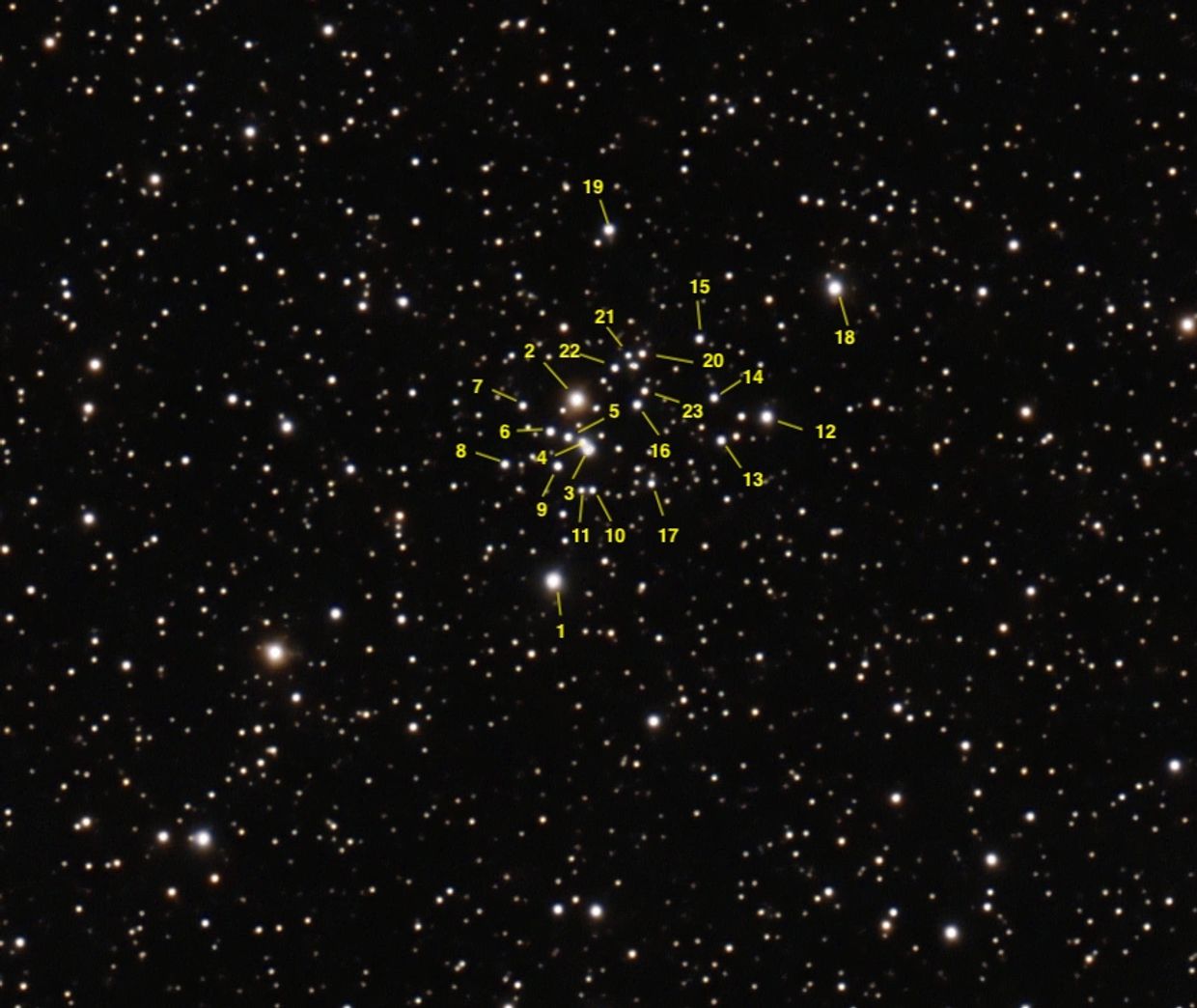
NGC 2186 is a faint open cluster in the constellation Orion. As one of the Herschel objects, I decided to capture this small group of stars, numbering 30 or less, to see how my Celestron Origin could resolve the members. The image is shown here along with my logbook entries for October 4, 2025. The cluster is centred in the field of view and, with the exception of the one bright star in the upper left, the entire star field is quite homogeneous in that there are no outstanding dark areas, just random stars scattered throughout. The cluster's magnitude and distance are approximately 8.7V and 6000 ly, respectively (Ref. 1).
Moffat and Vogt identified 23 members in their 1975 paper on southern open cluster photometry (Ref. 2) aimed at Milky Way structure research. They numbered them 1 to 23 and listed photometric results that included V, B-V, and U-B. The V-magnitude values are listed below with the Second Generation Digitized Sky Survey (DSS2) magnitudes in parentheses where they differ.
1. 9.64 (9.58)
2. 9.82
3. 10.86
4. 11.77
5. 12.71
6. 12.47
7. 13.21
8. 12.93
9. 12.46
10. 13.61
11. 14.24
12. 11.32
13. 12.57
14. 12.65
15. 13.07
16. 12.79
17. 13.71
18. 10.26 (10.25)
19. 11.67
20. 13.34 (?)
21. 14.14 (?)
22. 13.43 (?)
23. 13.65
References
1. The Complete Guide to the Herschel Objects, Mark Bratton, Cambridge University Press, Cambridge, UK, 2011, p. 354.
2. "Southern open star clusters IV. UBV-Hβ photometry of 26 clusters from Monoceros to Vela," A.F.J. Moffat and N. Vogt, Astron. Astrophys. Suppl. 20, 85-124, 1975.
Logbook
Date/Time: October 4, 2025, 1:57 a.m.
Location: Kempt Shore, Nova Scotia, 45°N
Sky: Clear, light breeze, 16°C
Moon Phase: Waxing gibbous (87%)
Moonset: 2:39 a.m.
Technical: 10-second exposures, 1-hour integration, battery & power tank, no filter, direct wifi, no post-processing

In progress ...
In progress ...
In progress ...
In progress ...
In progress ...
In progress ...
In progress ...
In progress ...